The Gallery Corridors
The Gallery Corridors
The Gallery Corridors
The Gallery Corridors


The Gallery Corridors
In their long-standing role as a precious treasure chest of art, the Uffizi’s three Corridors – east, south, and west - form a gallery that, since the 16th century, has become one of the most celebrated artistic spaces in the world. When Giorgio Vasari designed the building, the corridors were conceived as a loggia originally open onto the Piazzale degli Uffizi. Very soon, however, they evolved into a place of artistic excellence. In fact, the word “gallery,” now universally used to describe a collection of artworks, is widely believed to derive from this very setting.
Between the 16th and 19th centuries, the corridors were enriched with frescoed ceilings, elegant furnishings; and the walls covered with paintings, including the famous Jovian and Aulica series, which are still displayed today. Within this magnificent setting, the Grand Dukes of Tuscany exhibited above all the finest masterpieces from the Medici family’s collection of ancient statuary.
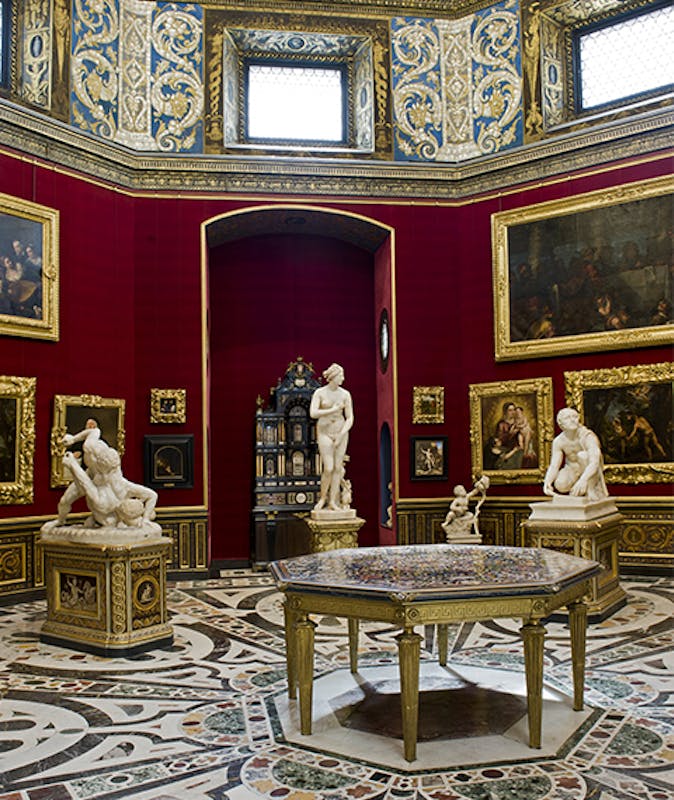
However, the three corridors were not used as an art gallery at the same time in history. The original princely Gallery, including the renowned Tribune, occupied only the east Corridor. This was also the first corridor to receive its fresco decoration, carried out during the 1580s at the request of the Grand Duke Francesco I de' Medici. Here he created the first nucleus of the Uffizi art collection, initially intended exclusively for him and his court.
From the 17th century onward, as the collection grew and artworks were progressively displayed in the second and third corridors, the Gallery gradually opened to a select number of visitors from outside the court.
The Uffizi’s collection of ancient statuary soon became one of the main attractions of the 18th century Grand Tour and an essential destination for scholars and art lovers from across Europe. Its fame became so widespread that the Grand Duke Peter Leopold of the House of Habsburg-Lorraine officially opened the Gallery to the public in 1769. On that occasion was built the large monumental entrance still in use today; while the original route, previously accessed through a small entrance in the third corridor, was reversed.
Vasari’s architectural design along the Uffizi’s exterior façade is reflected in the internal arrangement of the corridors, organized according to a harmonious triple division. Each section is composed of three large coffered bays connected by a narrower bay. Two ancient busts placed before the large windows correspond to two others on the opposite side of the corridor. Between the windows stand pairs of full-length statues facing one another, each surmounted by paintings from the Aulica Series. Above everything, the portraits of the Jovian Series uninterruptedly crown both sides of the corridors.


The Jovian and the Aulica Series
Simone Rovida

The Tribune
Bernardo Buontalenti ( Florence 1531 - 1608)